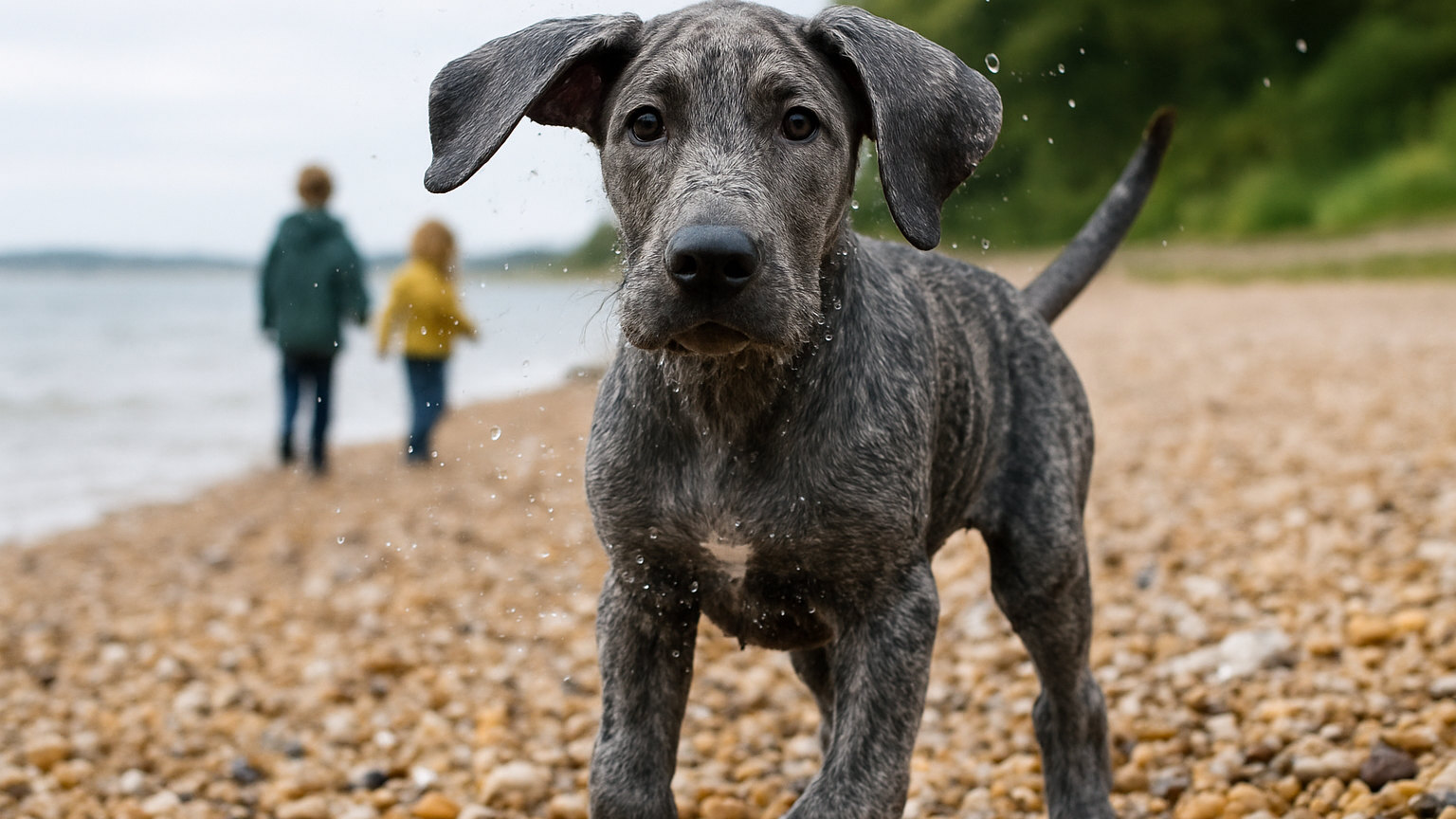
Great Danes are among the most affectionate and least demanding of the giant breeds, which is why people fall for them. They are also among the shortest lived dogs in existence, and that deserves honest thought before committing.
What is the temperament like?
Gentle, affectionate and notably calm. The nickname of gentle giant is largely accurate: most Danes are friendly with people, tolerant of children and not inclined to guard or challenge.
They are strongly people-oriented and want to be in the room with their family. Many are convinced they are lap dogs, which is charming at eight weeks and considerably more physical at seventy kilograms.
They are sensitive dogs. Shouting or heavy-handed methods produce anxiety rather than compliance, and reward-based training works far better.
How much exercise do they need?
Less than people expect. An adult Dane generally does well on around an hour a day at a moderate pace, and they are content to sleep for most of the rest.
Puppies are a different matter entirely, and getting this wrong causes lasting damage. Growth plates in a giant breed do not close until around eighteen months, and forced exercise before then contributes to joint disease.
Restrict lead walks, avoid stairs and jumping, and let the puppy potter at its own pace rather than taking it running.
What does the size mean day to day?
Everything is bigger. The bed, the crate, the food bill, the medication cost, the boarding fee and quite possibly the car. Counters and tables are within easy reach, so food must be genuinely put away.
A Dane can knock over a toddler or an unsteady adult simply by turning round. Teaching loose lead walking and a settle from puppyhood is not optional, because an adult that pulls cannot be held by most people.
They drool, some considerably, and it ends up on walls and clothing.
Why is the lifespan so short?
Great Danes typically live around seven to ten years, and eight is a common figure. A Dane is elderly at six or seven, showing greying and mobility changes at an age when a terrier is still behaving like a young dog.
The leading explanation is growth rate. Reaching seventy kilograms in eighteen months demands enormous cell division, which appears to carry a cost in both lifespan and cancer risk.
Osteosarcoma is notably more common in the breed than in most.
What is the bloat risk?
Significant, and it is the health issue Dane owners most need to understand. Gastric dilatation-volvulus, where the stomach fills with gas and twists, is a surgical emergency that kills within hours if untreated.
Deep-chested breeds are most at risk and Great Danes top the list. Signs include a swollen or hard abdomen, repeated unproductive retching, restlessness, pacing and drooling. Any of these means an immediate call to a vet.
Many owners elect for preventive gastropexy, a procedure tacking the stomach in place, often performed at the same time as neutering. It is worth discussing with a vet.
Are they suitable for families?
Yes, for families who understand what they are taking on. They are gentle, calm and genuinely lovely with children, and their exercise needs are modest.
What families should be prepared for is the cost, the physical management during adolescence, and the likelihood of losing the dog while children are still young. That last point is the one most people do not consider in advance.
What should you ask a Great Dane breeder?
Ask about longevity in the lines and how long the grandparents lived, and listen to how openly it is answered. Ask about hip and elbow scores and about cardiac screening, since dilated cardiomyopathy occurs in the breed.
Ask whether any close relatives have bloated, since family history increases risk, and whether the breeder recommends preventive gastropexy.
Be cautious of anyone breeding for extreme size or unusual colours. Exaggeration in a breed already at the limits of what a dog's frame can support tends to shorten life further rather than improve anything.