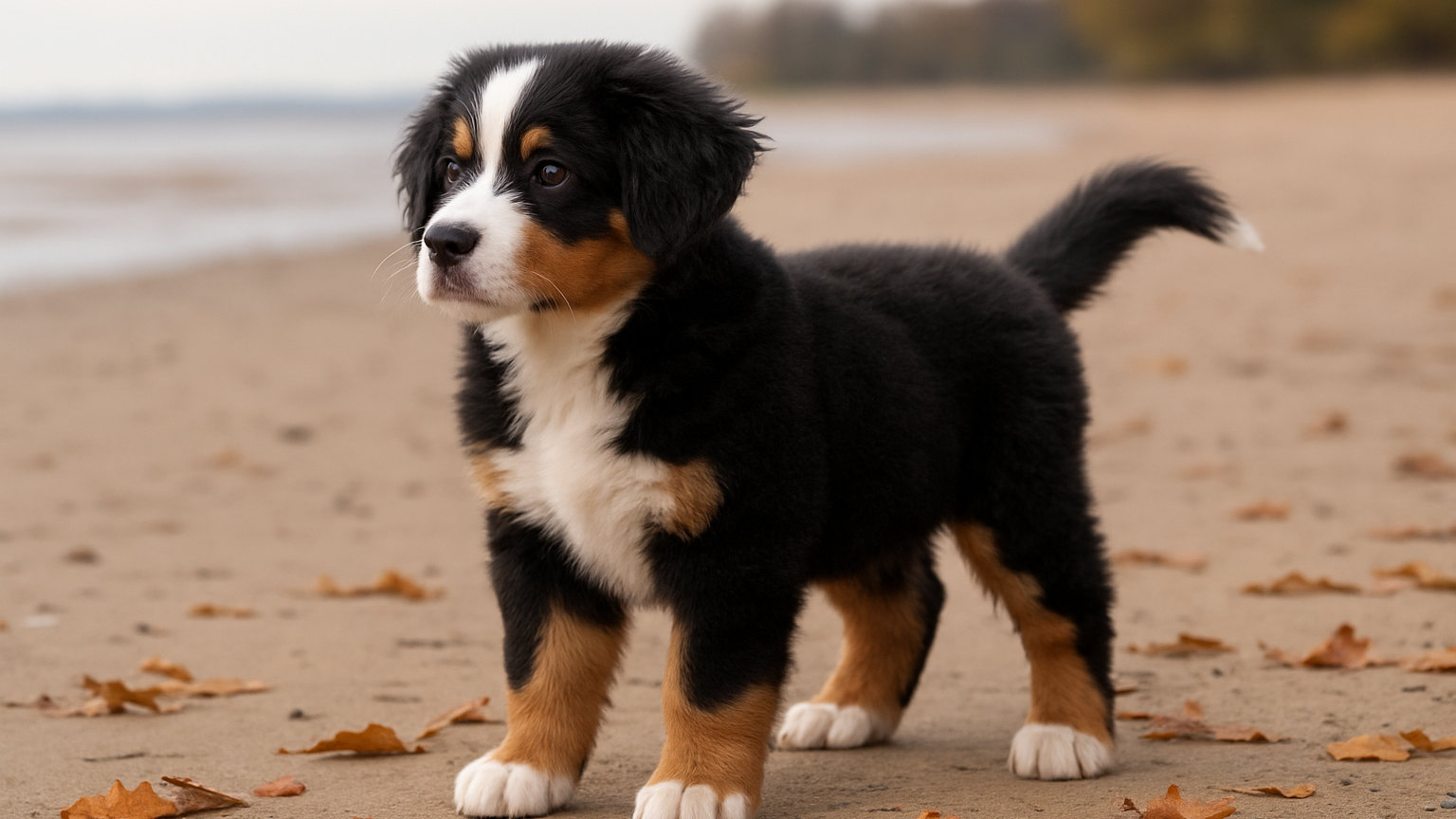
The Bernese Mountain Dog is one of the most appealing giant breeds: strikingly marked, famously good-natured and strongly attached to family life. It also carries a health burden that anyone considering one needs to understand fully.
What is the temperament like?
Calm, affectionate and notably good-natured. Bernese were developed as Swiss farm dogs, pulling carts, driving cattle and guarding property, which produced a steady rather than a driven dog.
They are strongly family-oriented and generally excellent with children, being patient and tolerant. Many are reserved with strangers initially rather than outgoing, and they warm up gradually.
They are sensitive and do not respond well to harsh handling. They also mature slowly, remaining puppyish in behaviour well past two years while being physically enormous.
How much exercise do they need?
Around an hour a day for an adult, at a moderate pace. They enjoy walking and are happy in cold weather, but they are not endurance athletes and they overheat readily.
Summer needs active management. A thick double coat and a heavy build make hot weather genuinely dangerous, so walk early or late and shorten sessions.
Puppies need their exercise carefully restricted while growth plates close at around eighteen months. Forced walking, running and stairs during that period contribute directly to joint disease later.
What is the grooming commitment?
Considerable. The long double coat sheds continuously and heavily, with two major moults a year when the volume is genuinely startling.
Brush two or three times a week as a minimum and daily during a moult, working right down to the skin rather than over the surface. Feathering behind the ears, on the legs and around the tail mats readily.
Never shave a double coat to reduce shedding or keep the dog cool. The undercoat insulates against heat as well as cold, and clipping can damage regrowth permanently.
Why is the lifespan so short?
Bernese Mountain Dogs have one of the shortest average lifespans of any breed, frequently around seven to eight years. Many owners lose them earlier.
Cancer is the dominant cause. The breed has particularly high rates of histiocytic sarcoma, an aggressive cancer that is uncommon in most breeds and disproportionately affects Bernese. Osteosarcoma and lymphoma also occur.
This is not something a buyer can fully avoid through breeder selection, though choosing lines with documented longevity is worth doing and worth asking about directly.
What other health issues occur?
Hip and elbow dysplasia are common and both parents should be scored. Cruciate ligament rupture is frequent in the breed, and keeping the dog lean reduces the risk considerably.
Bloat is a risk as with other deep-chested giants, and owners should learn the signs. Some lines carry degenerative myelopathy, for which a DNA test exists. Eye conditions are also screened for.
Should you consider one?
They are wonderful dogs and there is a reason people who own one often go on to own several. What matters is going in with clear expectations.
Budget generously, insure early with lifetime cover, choose a breeder who tests thoroughly and talks openly about longevity in their lines, and accept that the time you get is likely to be short. For many owners that trade is worth making, but it should be a decision rather than a surprise.
Are they good with children and other pets?
Generally excellent. Bernese are patient, tolerant and rarely possessive, and they usually get on well with other dogs and with cats they are raised alongside.
The practical issue is size and clumsiness. An adolescent Bernese is large, heavy and not yet coordinated, and can knock a small child over without any intent. Teaching a calm greeting and a settle early matters.
They are also strongly attached to their families and do not do well left alone for long periods, which is worth planning for from the first week.
Ask any Bernese owner and they will tell you the years are short and worth it. Going in knowing that, rather than discovering it at six, is what separates a heartbreaking surprise from a decision made with open eyes.