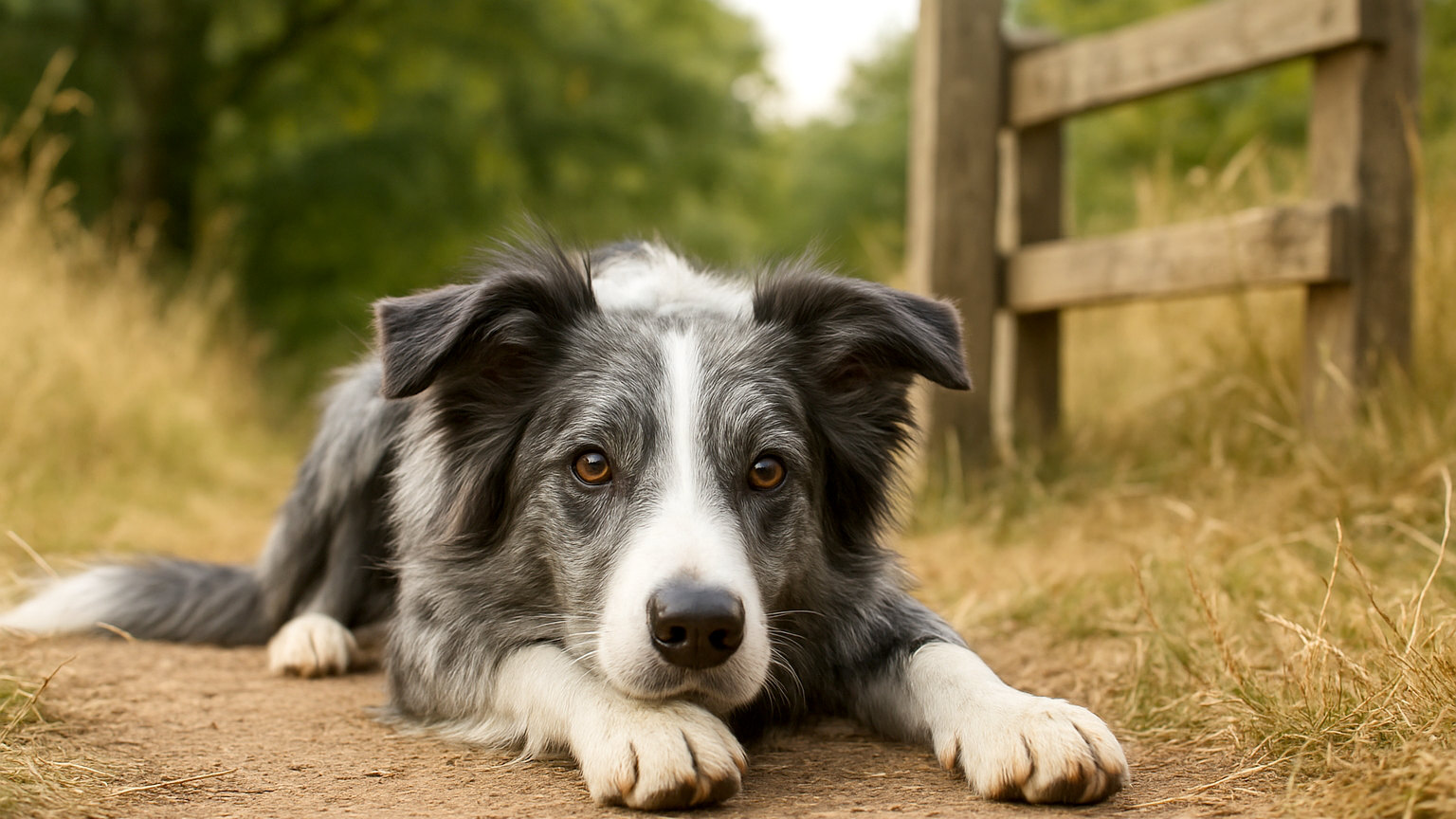
Border Collies are frequently described as needing enormous amounts of exercise, and owners often respond by walking further and throwing a ball for longer. That approach usually produces a fitter dog with the same problems, and sometimes a worse one.
Why is distance the wrong measure?
The Collie was bred to work sheep, which is a task requiring sustained concentration, quick decisions and constant response to a handler. What the breed selects for is mental engagement, not mileage. A Collie walked for two hours with nothing to think about has been exercised but not satisfied.
Worse, a dog conditioned to long, high-intensity physical work simply becomes fitter, so the same routine achieves less each month. Owners describe an escalating arms race they cannot win. The dog that needed an hour now needs two, and still paces the house in the evening.
What does a Collie actually need each day?
A reasonable target for an adult is around an hour to ninety minutes of physical activity combined with twenty to forty minutes of genuine mental work. The mental component is the part most often missing.
Useful mental work includes scent games, hiding food around the garden, teaching new tricks, formal obedience, shaping behaviours with a clicker, puzzle feeders and structured tasks like finding named toys. Ten minutes of learning something new will settle a Collie more effectively than a third walk.
Dog sports suit the breed exceptionally well. Agility, obedience, flyball, canicross, scent work and herding classes all give the dog a defined job with rules, which is precisely what it was built for.
Why is repetitive ball throwing a problem?
Chasing a thrown ball is self-reinforcing and highly arousing. Collies in particular can become fixated to the point where the behaviour resembles compulsion, and the sustained adrenaline leaves them unable to settle for hours afterwards. It also places repeated strain on joints through hard braking and twisting.
Ball work is not banned, but it works better in short, structured sessions with clear start and stop cues, mixed with calmer activities, rather than as the default form of exercise.
How do you teach a Collie to settle?
Deliberately, because many never learn it on their own. Reward calm behaviour on a mat or bed, use a chew or a stuffed feeder to create genuine downtime, and build a predictable daily rhythm so the dog is not constantly anticipating the next thing.
Enforced naps help enormously with young Collies, who frequently become frantic when overtired in much the same way a small child does. Many owners find that reducing stimulation improves behaviour more than adding activity.
What about puppies?
Restrict formal exercise while joints develop, using roughly five minutes per month of age twice a day as a guide. Fill the gap with training and scent games rather than distance. A Collie puppy taught to think and to settle becomes a far easier adult than one simply run into the ground.
Is the breed right for you?
Border Collies are outstanding for people who want to train, compete or work with a dog daily. They are a poor fit for households wanting a companion that fits around a busy life, and they are frequently rehomed by owners who underestimated the mental side. Sensitivity to noise and movement also means many find chaotic households genuinely stressful.
Are Border Collies good with children?
They can be excellent, with one specific caveat. Collies were bred to control movement, and running, shrieking children trigger exactly that instinct. Circling, chasing and nipping at heels is herding behaviour rather than aggression, but it frightens children and needs redirecting early onto an appropriate outlet.
Collies are also noise sensitive, and a loud, unpredictable household can be genuinely stressful for them. Give the dog a quiet retreat it is never disturbed in, and teach children to interact calmly. In a busy family the Collie's sensitivity, rather than its energy, is often the harder issue.