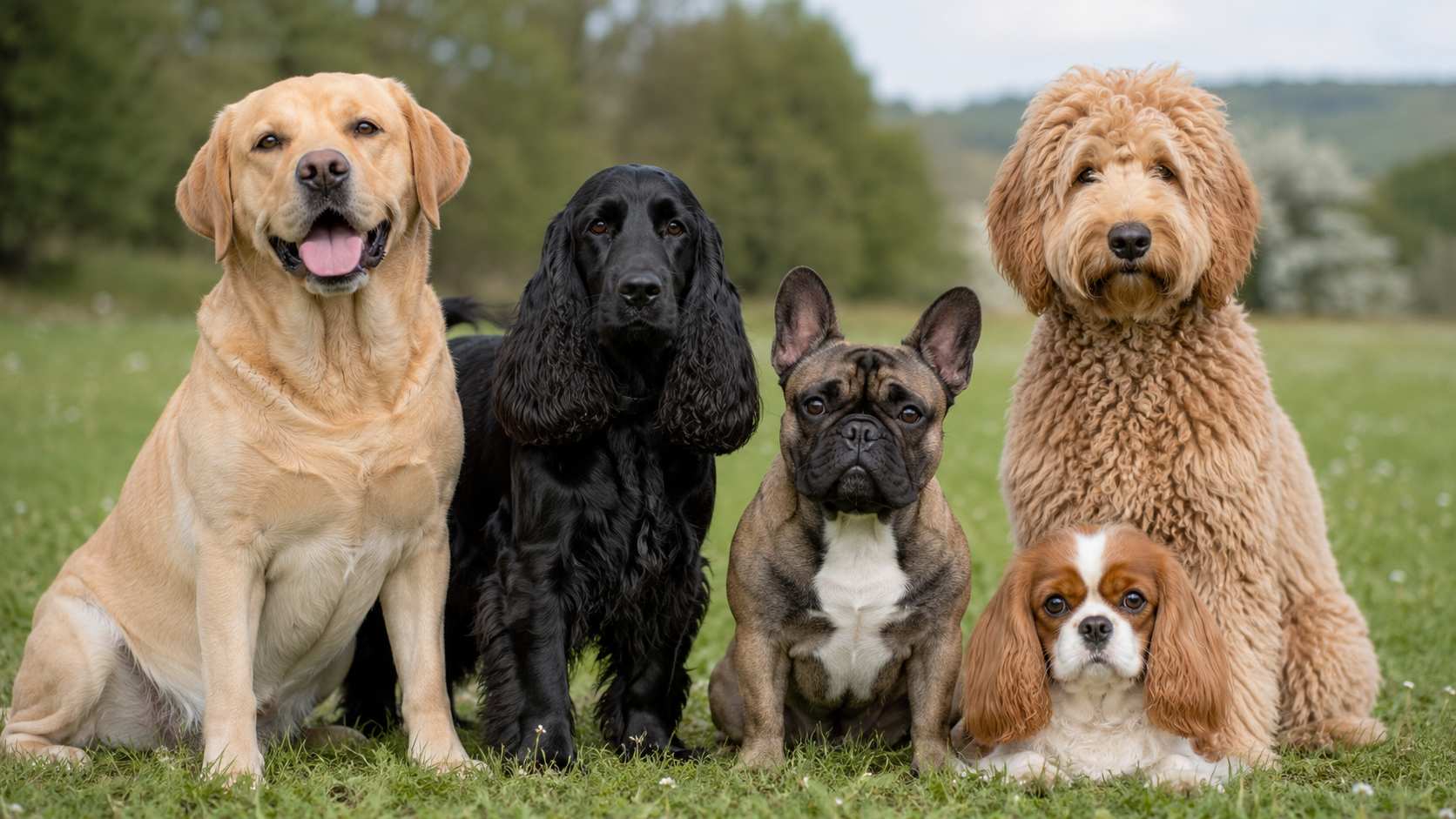
The assumption that a small dog needs a small amount of exercise is one of the most common reasons people end up with a dog they cannot live with. Size tells you how far a dog can comfortably walk. It tells you very little about how much it needs to do.
What actually determines exercise needs?
Breeding purpose, not body weight. A dog bred to work all day will need an outlet whatever its size, and a dog bred purely for companionship will usually be content with far less.
Working terriers are the clearest example. Jack Russells, Border Terriers, Patterdales and Lakeland Terriers were bred to work underground and across rough ground for hours. An adult Jack Russell frequently needs more than an hour a day plus regular mental work, which is comparable to a Labrador.
Miniature Schnauzers, Shetland Sheepdogs and Miniature Poodles are similarly busy. All were bred to do a job and all become destructive or vocal when underemployed.
Which small breeds genuinely need less?
Companion breeds developed to sit with people rather than work. Cavalier King Charles Spaniels, Shih Tzus, Maltese, Pekingese and Bichon Frise generally do well on thirty to sixty minutes a day split into shorter walks.
Flat-faced breeds such as Pugs need less again, not because they lack enthusiasm but because their breathing limits what they can safely do, particularly in warm weather.
Even these breeds still need something. A dog that never leaves the house becomes anxious, unfit and difficult, and daily walks matter for reasons beyond physical fitness.
Why does mental work matter so much?
Because most small dogs are far easier to tire mentally than physically. Twenty minutes of scent work in the garden will settle a terrier more effectively than a third walk round the block.
Scatter feeding in grass, hiding treats around a room, puzzle feeders, teaching new tricks and short training sessions all engage the brain. For working breeds this is not a supplement to exercise but a core part of it.
Chewing also matters. A safe chew provides genuine decompression, and many small dogs settle far better in the evening with one.
How much is too much for a small dog?
Puppies of any size need restricted formal exercise while their joints develop, with roughly five minutes per month of age twice daily as a working guide. Toy breeds are particularly fragile and can be injured jumping from furniture.
Very small dogs also tire and chill more quickly in cold, wet weather because of their surface area relative to body mass. Shorter, more frequent walks suit them better than one long outing.
Flat-faced breeds need active limiting in warm conditions. Noisy breathing, excessive drooling or reluctance to continue means stopping immediately.
How should you plan a daily routine?
Work out what the breed was bred to do, then build a routine around that rather than around size. A realistic pattern for a busy small breed is two walks with sniffing time, one short training session and one enrichment activity.
Sniffing deserves particular emphasis. Letting a dog investigate at its own pace is genuinely tiring and is often more valuable than covering more ground. A walk where the dog is dragged past everything interesting achieves considerably less than a slower one.
What happens when small dogs are under-exercised?
The signs are consistent and easily mistaken for personality. Barking at minor noises increases, chewing and digging appear, the dog becomes difficult to settle in the evening, and lead pulling gets worse rather than better.
Owners frequently interpret this as a badly behaved dog and respond with more management and less freedom, which compounds the problem. The dog is not being difficult; it has energy and no legitimate outlet for it.
Adding twenty minutes of scent work and one short training session daily changes the picture in most cases within a fortnight, which is a useful diagnostic in itself.
A useful test is what the dog does in the evening. A well-exercised dog of any size sleeps. One that paces, stares at you or brings toys repeatedly at nine at night is telling you the day was not enough.