Ticks are common across the UK, particularly in long grass, woodland, moorland and areas with deer or livestock. Removing one properly takes seconds and doing it badly increases the risk of disease transmission.
What do ticks look like?
Before feeding they are small, flat and spider-like, often only a few millimetres across and easily mistaken for a scab or skin tag.
As they feed they swell considerably, becoming grey, pale or bluish and rounded, at which point they are much easier to spot.
Look closely for legs, which distinguish a tick from a skin lump. They attach most often around the head, neck, ears, armpits, groin and between the toes.
What is the best way to remove one?
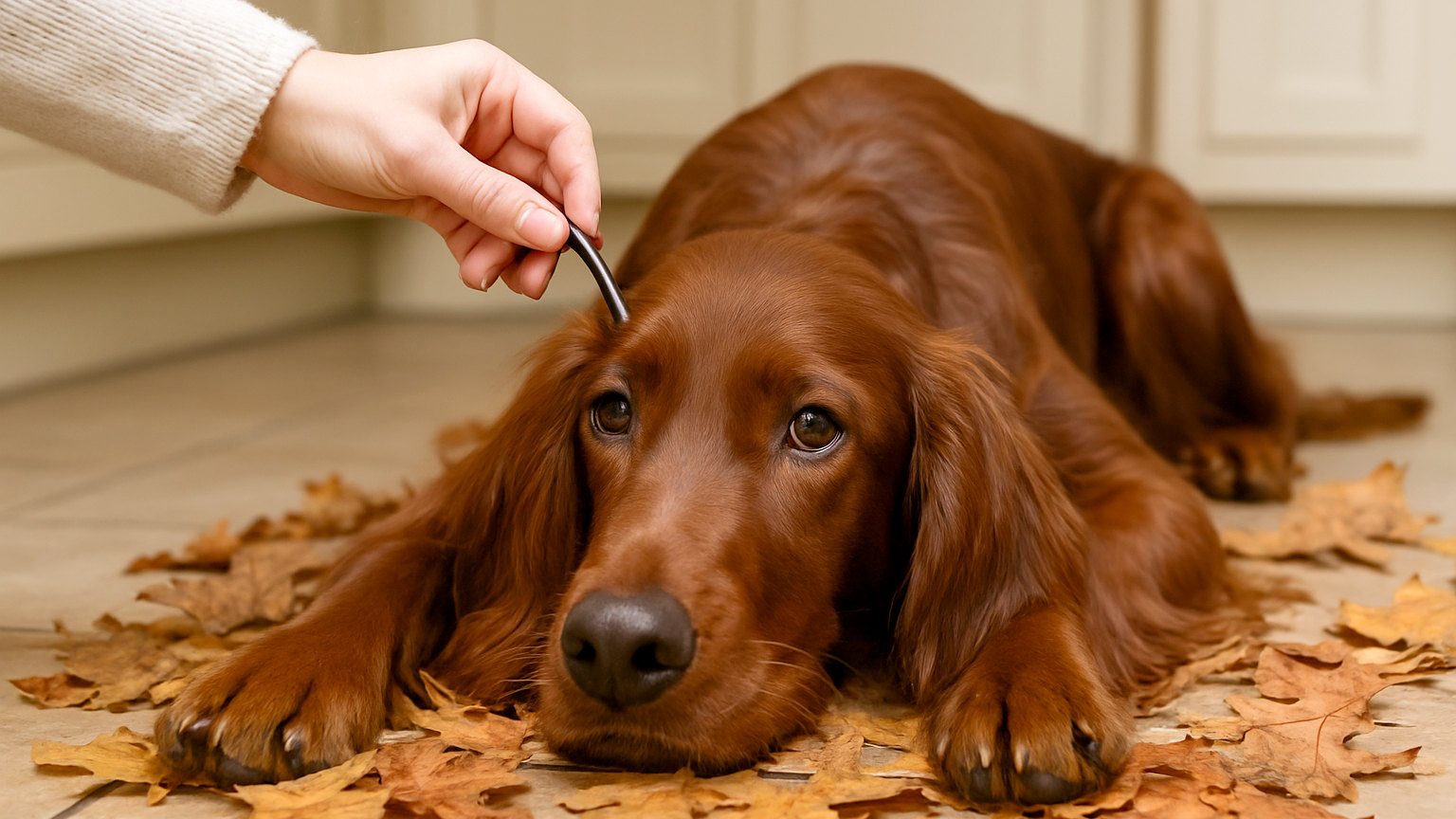
A tick removal hook, which is inexpensive and belongs in every dog first aid kit. Slide the fork of the hook around the tick close to the skin.
Then twist steadily, two or three rotations, and the tick releases its grip and lifts away whole. The twisting motion is what makes it let go.
Fine-tipped tweezers can be used by gripping the tick as close to the skin as possible and pulling straight out with steady even pressure, without squeezing the body.
What should you never do?
Do not apply anything to make the tick detach: no petroleum jelly, alcohol, nail varnish, essential oils or lit matches.
These distress the tick and can cause it to regurgitate its stomach contents into the wound, which is precisely the mechanism by which disease is transmitted.
Do not squeeze the body, which has the same effect. Do not pull sharply, which leaves mouthparts embedded, and do not burn it.
What if part of it is left behind?
Small remnants of mouthparts usually work their way out on their own over a few days, in much the same way as a splinter.
Clean the area, leave it alone and monitor it. If it becomes red, swollen, painful or discharges, see a vet.
Do not dig at the site trying to extract fragments, which causes more inflammation than the fragment itself.
What should you do afterwards?
Clean the area with an antiseptic suitable for animals or with saline. Wash your hands thoroughly, since ticks can transmit disease to people too.
Dispose of the tick by putting it in a sealed bag or container rather than crushing it between your fingers. Some owners keep it in case identification is needed.
Note the date and where on the body it was, since that helps if the dog becomes unwell later.
What should you watch for?
A small red area at the site for a few days is normal. Watch for spreading redness, swelling or discharge.
More importantly, watch the dog for several weeks. Lethargy, lameness that shifts between legs, fever, reduced appetite, swollen joints or pale gums all warrant a veterinary appointment, and mention the tick.
How do you check for ticks?
Run your hands over the whole dog after walks in long grass, woodland or moorland, feeling for small bumps.
Check the head, ears, neck, armpits, groin and between the toes particularly. Ticks generally need to be attached for some hours before transmitting disease, so prompt removal genuinely reduces the risk.
Effective tick prevention is available and worth discussing with your vet if you walk regularly in tick habitat.
What about ticks on people?
The same ticks bite people, and the removal technique is identical. Check yourself after the same walks, particularly behind the knees, around the waistband, the groin and the hairline.
Children should be checked carefully, including the scalp and behind the ears, where ticks are easily hidden by hair.
See a doctor if a spreading circular rash appears at the site, or if flu-like symptoms develop in the weeks afterwards.
Keep a tick hook in your first aid kit, in the car and in your walking bag. They cost very little and having one to hand is the difference between removing a tick properly and improvising badly.
Above all, do not panic on finding one. Ticks are common, most bites transmit nothing, and calm removal with the right tool takes a few seconds.