Most of a dog's life is spent doing nothing. Teaching a puppy to do that calmly is among the most valuable things you can invest time in, and it is rarely on anyone's list.
Why is it a skill?
Because in a busy household there is always something happening, and a puppy that has never learned to switch off simply waits for the next event.
Owners frequently reinforce this without meaning to. If the puppy only gets attention when it brings a toy, barks or jumps up, it learns that activity produces interaction and quiet produces nothing.
What is capturing calm?
The simplest technique and the most underused. When the puppy lies down quietly of its own accord, quietly drop a treat beside it without saying anything or making a fuss.
Do this several times a day. The puppy learns that lying calmly produces good things, without the excitement that praise would generate.
Do it while you are doing something else. The point is that calm is rewarded during ordinary life rather than in a training session.
How do you teach a settle on a mat?
Choose a mat or bed used only for this. Put it down, and reward any interaction with it, then reward standing on it, then lying on it.
Once the puppy offers lying down, reward at intervals while it stays there. Start with a few seconds and build gradually.
Add a cue such as settle once the behaviour is reliable. Practise in different rooms, then with mild distractions, then in a cafe or at a friend's house.
The mat becomes portable, which is genuinely useful: a puppy that settles on its mat anywhere is welcome in far more places.
What role do chews play?
A considerable one. Chewing and licking are self-soothing behaviours that lower arousal, so a chew or a stuffed frozen toy helps a puppy wind down rather than simply being contained.
Use one at predictable times: after a walk, during the evening, when visitors arrive. Over time the routine itself becomes calming.
Why does rest matter so much?
Because puppies need eighteen to twenty hours of sleep a day and rarely take it voluntarily in a busy home.
An overtired puppy becomes frantic, mouthy and unable to settle, which looks exactly like too much energy. Owners then add exercise, which makes it worse.
Enforced naps in a quiet space after every period of activity resolve a great deal of what gets described as hyperactivity, usually within a few days.
How does routine help?
Dogs settle better when the day has a predictable shape, because they are not constantly anticipating what comes next.
Build in a genuine rest period after each walk, so activity is followed by downtime as a pattern. Keep the last hour before bed calm.
What should you avoid?
Reserving all attention for when the puppy is active. Constant low-level stimulation with nowhere quiet to retreat to.
Assuming a puppy that will not settle needs more exercise. Try a week of proper rest first, since it is the cheapest intervention available and frequently the answer.
What does a settled puppy look like?
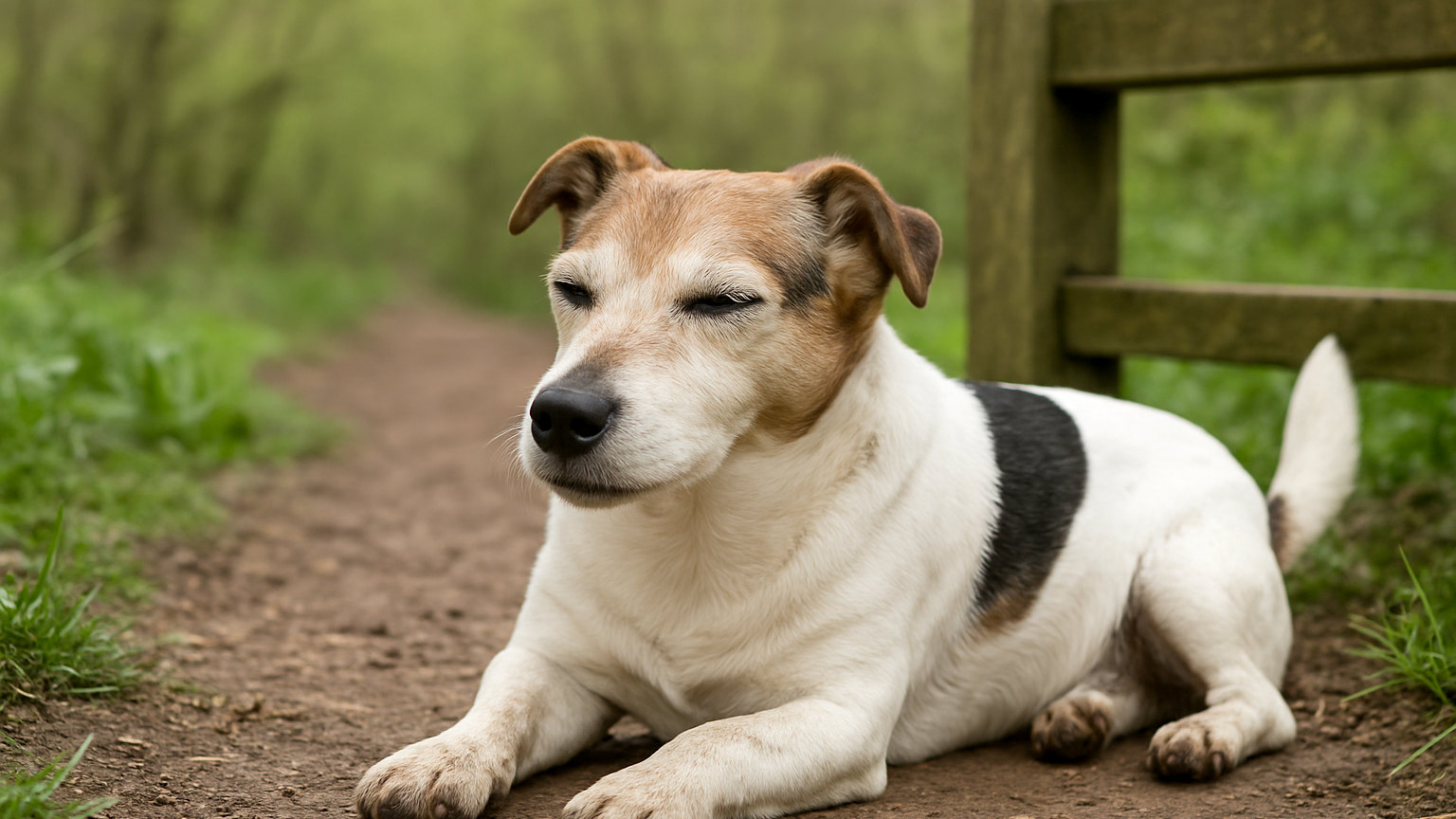
Lying down with its weight fully on the floor, breathing slowly, sometimes with a sigh as it releases tension. Not lying alert with its head up, watching for the next thing.
Learn to notice the difference, since a puppy that is contained but tense is not resting even if it looks quiet.
How long does it take?
Weeks rather than days, with steady improvement. Most puppies can hold a settle for a few minutes within a fortnight and considerably longer by four or five months.
Expect setbacks during adolescence, when previously settled dogs become restless again. This is normal and responds to going back a stage rather than escalating.
Of all the things you can teach a puppy, this is the one that most affects daily life. A dog that can switch off is welcome everywhere and easy to live with, and it is entirely a trained skill.