The long line is the most useful piece of training equipment most owners have never used. It solves the central problem of recall training: how to practise freedom without risking failure.
What is it for?
Allowing a dog to move, sniff and explore at a distance while remaining under your control.
The point is not to physically haul the dog back. It is to prevent the dog rehearsing ignoring you, and to let you practise recall at realistic distances with a guarantee of success.
Every recall the dog ignores makes the next one less likely. A line stops that happening while training is still being built.
What length should you use?
Five to ten metres suits most situations. Shorter than five gives little freedom; longer than ten becomes difficult to manage and tangles constantly.
Biothane and similar coated materials are easier to handle than rope or webbing, do not absorb water, and can be wiped clean. Rope lines cause the worst friction burns.
Avoid lines with heavy clips on small dogs, and check the clip regularly since it takes considerable force.
Why must it attach to a harness?
Because a dog hitting the end of a ten-metre line at speed generates enormous force. On a collar that goes entirely through the neck, risking damage to the trachea and spine.
A well-fitted harness spreads that load across the chest. This is not optional with a long line, it is the single most important safety point.
Use a harness with a back attachment point for a long line rather than a front one, which twists the dog awkwardly at distance.
How do you handle it without injury?
Wear gloves. A line running through a bare hand at speed causes serious friction burns, and this is the most common injury owners sustain.
Never wrap the line around your hand, wrist or waist. If the dog bolts, you will be pulled over or the line will tighten on your fingers.
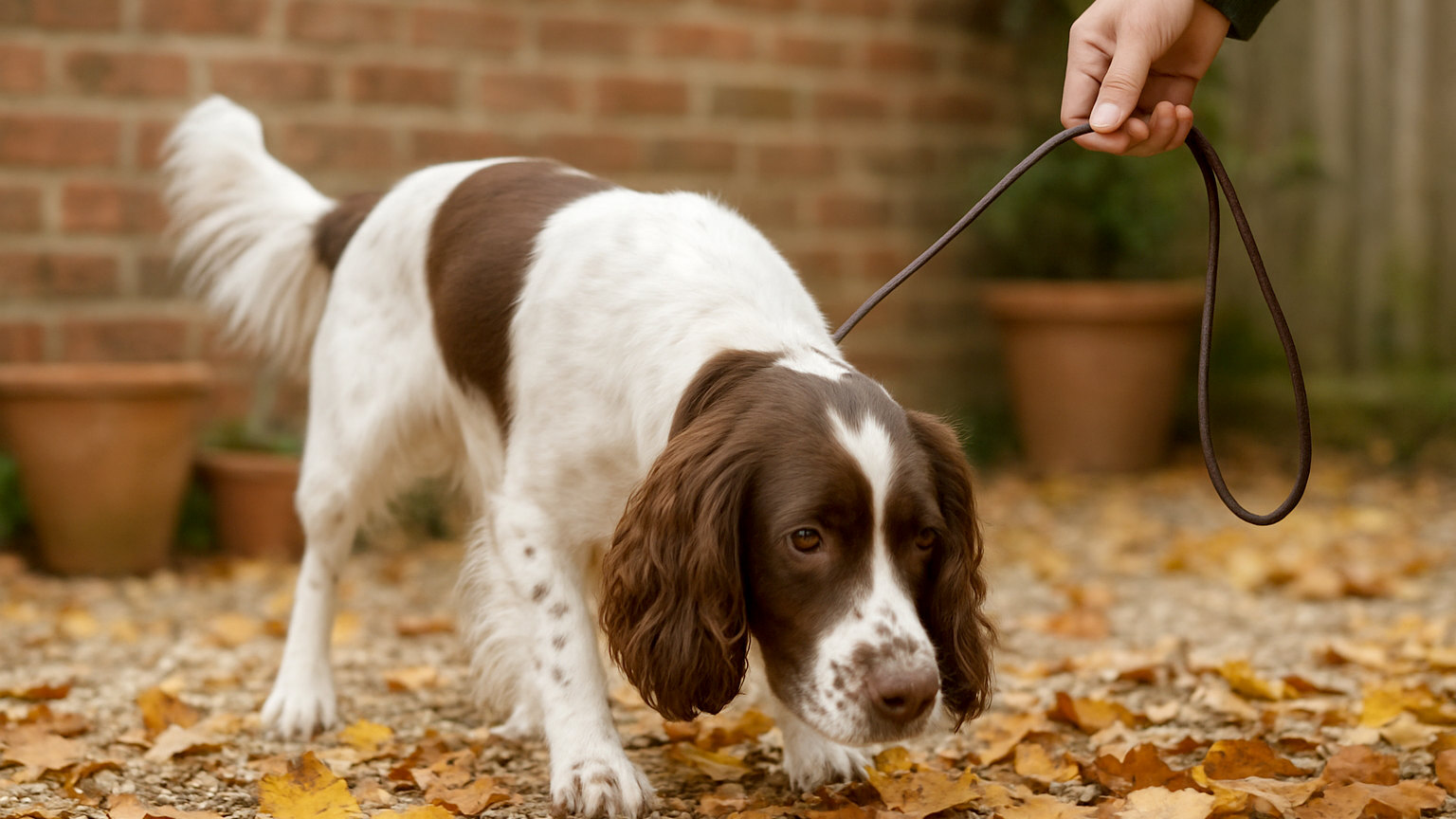
Let it trail on the ground rather than holding it taut, and simply stand on it if you need to stop the dog. Keep the slack gathered loosely rather than coiled around anything.
Where should you use one?
Open spaces with few obstacles. Woodland is difficult because the line catches on everything, and busy paths are awkward because it trips other people.
Be aware of other dogs and walkers, since a trailing line is a hazard. Gather it in when someone approaches.
Avoid using one near water where it could snag, and never leave a dog unsupervised on a trailing line.
How do you use it for training?
Let the dog wander and sniff. Periodically call it, and if it responds, reward heavily and release it again.
If it does not respond, do not reel it in like a fish. Move away, make an encouraging noise, and use the line only to prevent it going further while you make yourself interesting.
Gradually reduce reliance until the line is trailing untouched, then try a shorter line, then a secure field off lead.
What about secure fields?
Fenced fields available to hire have become widespread across the UK and are genuinely useful for dogs whose recall is unreliable.
They let a dog run properly without risk, which matters for high prey drive breeds where full off-lead freedom in open country may never be safe.
How do you transition off the line?
Gradually rather than all at once. Move from ten metres to five, then to a two-metre trailing line, then to a short length of cord attached to the harness.
The short trailing cord is a useful intermediate stage, since you can still step on it while the dog experiences near-total freedom.
If recall fails at any stage, go back a step for a fortnight rather than persisting and letting the dog rehearse ignoring you.
A long line is not an admission that training has failed. It is the tool that makes training possible, and most good trainers use one for months rather than weeks.