How much to feed is the question owners get wrong most often, and the consequences accumulate quietly. Overfeeding is the most common preventable problem in British dogs, and it starts with following the bag.
Why are packet guidelines unreliable?
Because they describe an average dog rather than yours. Guidelines are calculated for an intact, moderately active adult, and most pet dogs are neutered and less active than that.
Neutering reduces energy requirements noticeably, frequently by around a quarter. A neutered dog fed the packet amount will usually gain weight steadily.
Age, breed, metabolism, whether the dog is indoors most of the day and how cold the weather is all shift the requirement. Treat the guideline as a starting point and adjust from there.
How do you know if the amount is right?
By body condition rather than by the number on the bag. Run your hands along the ribs: you should feel them easily under a thin layer of covering, in much the same way you can feel the back of your own hand.
Look down from above and you should see a definable waist behind the ribs. From the side, the belly should tuck up rather than running straight or sagging.
Ribs that are hard to find mean too much. Ribs that are visible and sharply defined with obvious hip bones mean too little.
Why does weighing matter more than scooping?
Because scoops are wildly inconsistent. The same scoop filled by two people can differ by a substantial margin, and a small daily excess becomes several kilograms over a year.
Kitchen scales cost very little and remove the guesswork entirely. Weigh the daily total in the morning and take treats from it rather than adding them on top.
This single change resolves a great many weight problems without any other intervention.
How quickly should you adjust?
Slowly. Change the amount by around ten per cent and give it three to four weeks before judging, since day-to-day fluctuation means short-term comparisons are meaningless.
Weigh the dog on the same scales at the same time of day. Many veterinary practices have scales in reception and are happy for you to use them without an appointment.
Aim for gradual change. Rapid weight loss is not desirable, and a sensible target is around one to two per cent of body weight per week.
Does the type of food change the amount?
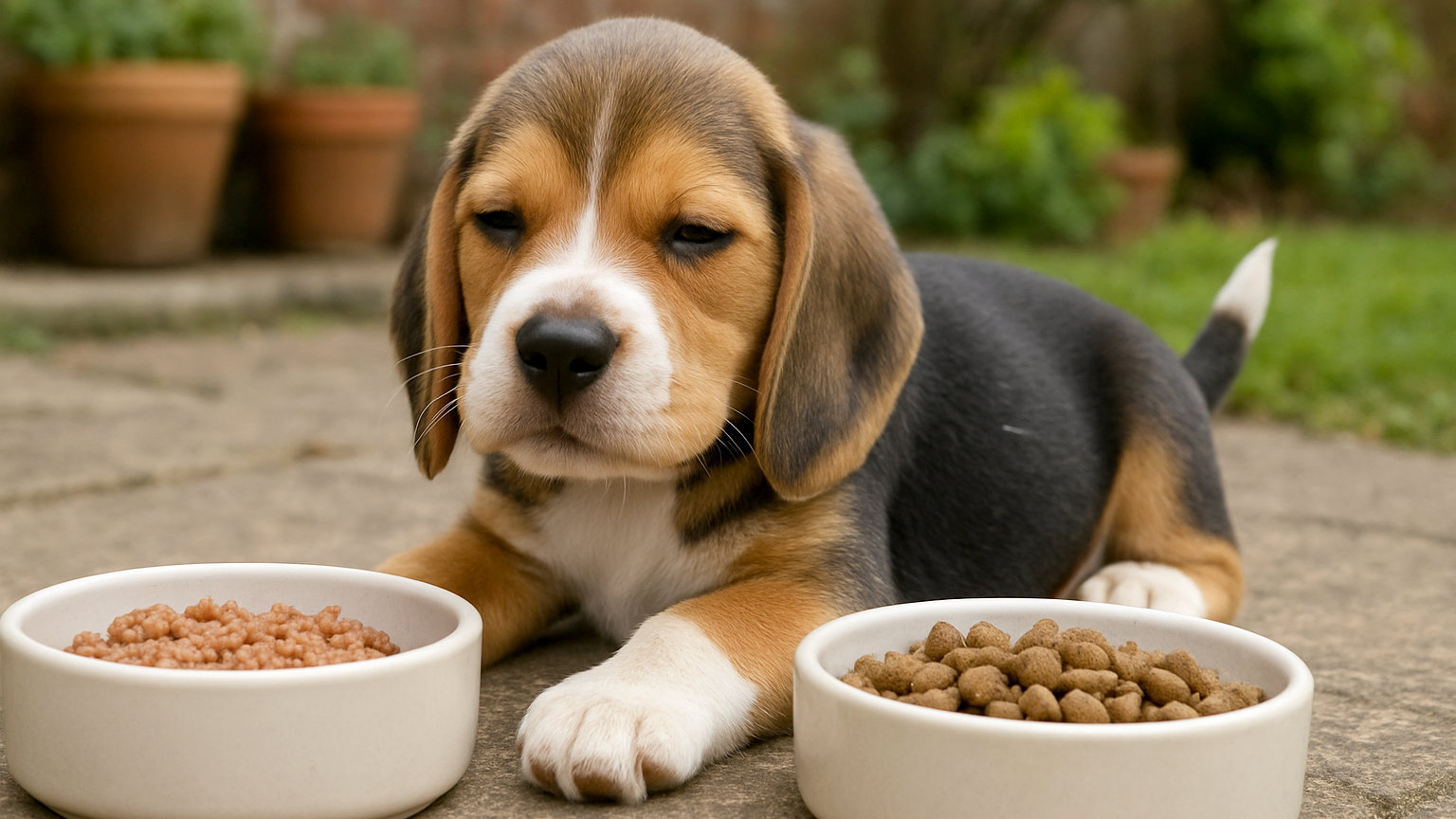
Considerably. Dry food is far more calorie dense than wet, so the volumes are not comparable at all. A cup of one is not equivalent to a cup of another.
Different brands vary too, sometimes substantially, so the amount that suited one food may be wrong for the next. Recalculate whenever you switch rather than assuming.
Always feed by weight in grams rather than by volume, since kibble size affects how much fits in a cup.
What about dogs that always seem hungry?
Some breeds genuinely are. Labradors frequently carry a genetic variant affecting appetite regulation, which means they do not experience fullness the way other dogs do.
Behaviour is not a reliable guide to whether a dog needs more food. A dog performing starvation twenty minutes after eating is usually performing.
Spreading the same total across more meals, using puzzle feeders to slow eating, and adding low-calorie bulk such as green beans can help a dog feel more satisfied on the same intake.
When should you ask a vet?
If a dog is losing or gaining weight despite consistent feeding, that warrants investigation rather than adjustment. Thyroid problems, diabetes and other conditions all present this way.
Puppies, pregnant or nursing bitches, working dogs and dogs with diagnosed conditions all have requirements a general guide cannot cover, and are worth discussing with your own vet.
Does activity level change the amount much?
Less than owners assume for an ordinary pet dog. An extra half hour of lead walking makes a modest difference, and it is difficult to exercise a dog out of a consistent surplus.
Genuinely working dogs, dogs doing sustained canicross or agility, and dogs kennelled outdoors in winter do need noticeably more. A pet dog walked an hour a day generally does not.
Adjust for the season too. Many dogs need slightly less through summer when they move about less, and the drift upwards over a warm few months is easy to miss.