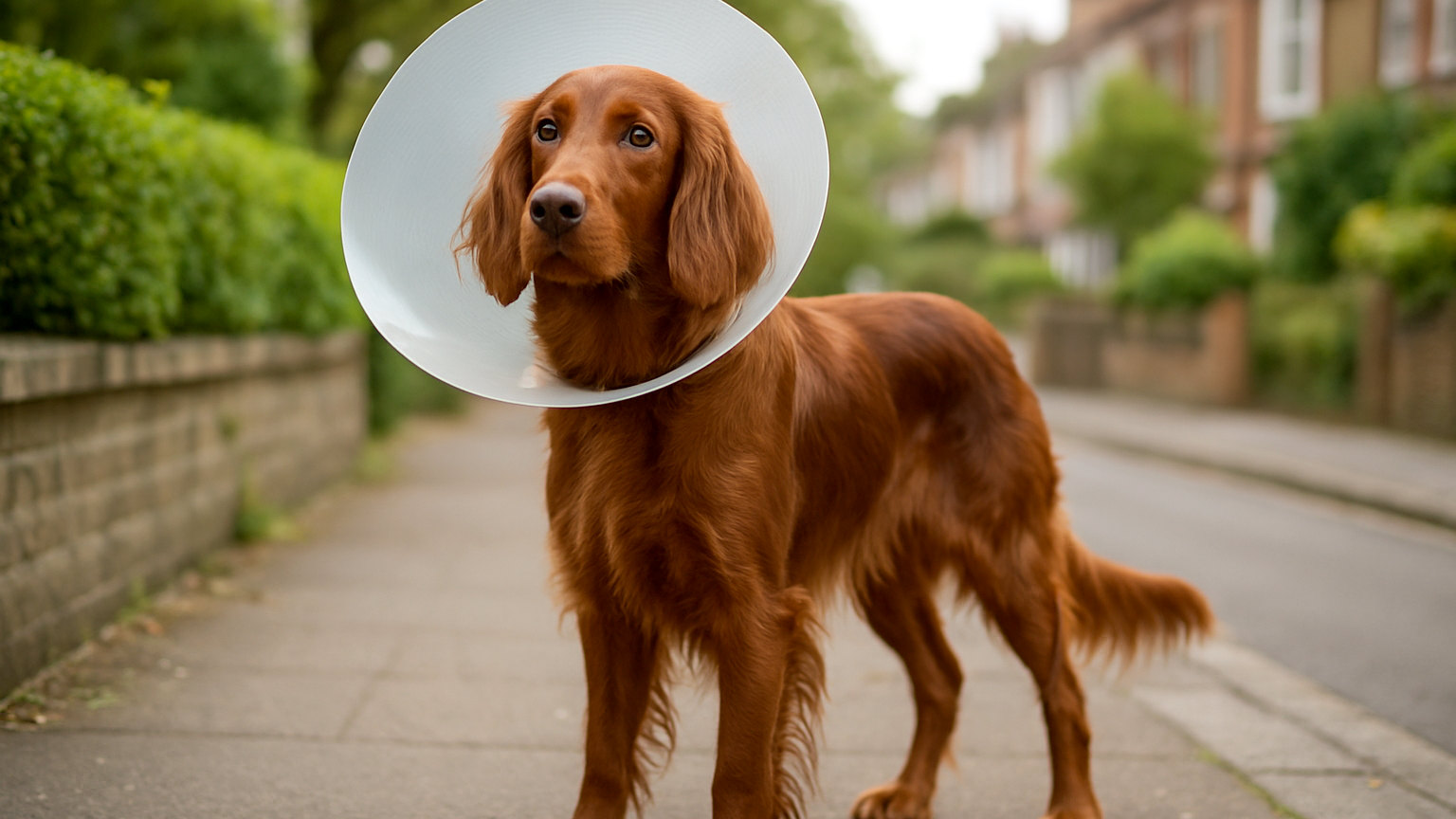
Almost every owner feels sorry for a dog in a cone and many take it off early. Wound breakdown from licking is one of the most common post-operative complications, and it is entirely avoidable.
Why does it have to stay on?
Because a dog's tongue is abrasive and its mouth carries bacteria. Licking introduces infection, pulls at sutures and can open a wound within minutes.
A dog can undo a surgical site quickly and quietly, often overnight. The consequences range from delayed healing to a second anaesthetic to repair it.
The idea that a dog licking a wound helps it heal is not correct. It reliably makes things worse.
How long is it needed?
Usually ten to fourteen days, until the wound has healed and sutures are removed or dissolved. Follow the practice's specific advice.
It needs wearing at all times, including overnight and when you are in the room, since it takes seconds of unsupervised licking to cause a problem.
The temptation to remove it for meals or sleep is where most failures happen.
How do you fit it correctly?
It should extend beyond the nose so the dog cannot reach the wound, and attach securely to the collar so it cannot be backed out of.
Check you can fit two fingers between the neck and the collar. Too loose and the dog escapes it; too tight and it causes discomfort and rubbing.
Check daily for rubbing around the neck, which is a common problem, particularly in short-coated breeds.
What are the alternatives?
Inflatable collars sit around the neck like a travel pillow and are more comfortable for many dogs. They work well for body wounds but not for dogs that can still reach paws or hindquarters.
Soft fabric cones are less rigid and better for indoor movement, though determined dogs squash them and reach through.
Recovery suits, which are close-fitting garments covering the body, are excellent for abdominal wounds such as spay incisions and are usually better tolerated than a cone.
Check with the practice which is appropriate, since the right choice depends entirely on where the wound is.
How do you manage eating and drinking?
Many dogs manage in the cone with bowls raised slightly or moved into an open space where the cone is not blocked by walls.
Shallow, wide bowls are easier than deep ones. Some dogs need a flat plate initially.
If the dog genuinely cannot eat, supervise closely with the cone off and replace it immediately afterwards. Never leave it off unattended.
How do you help the dog adjust?
Most adjust within a day or two. Clear a route through the house, since dogs bump into door frames and furniture and can knock things over.
Use stair gates if the dog is unsteady, and supervise on stairs. Keep the household calm rather than reacting anxiously, as dogs pick up on it.
Give plenty of gentle attention, and use lickmats or stuffed toys for mental stimulation during restricted exercise.
What should you watch for?
Redness, swelling, discharge, a foul smell, gaping edges or the dog seeming painful at the site. Any of these needs a call to the practice.
Also watch for a dog that stops eating, becomes lethargic, or seems distressed rather than merely inconvenienced.
What about exercise during recovery?
Follow the practice's instructions precisely, since restricted exercise is usually as important as the cone. Lead walks only, no running, no jumping and no stairs where possible.
A dog that feels well after a few days will try to do too much, and this is when wounds break down. Restrict access with stair gates rather than relying on supervision.
Replace physical activity with mental work. Lickmats, stuffed frozen toys and simple nose work done lying down keep a confined dog settled without risking the wound.
Ten days of an unhappy dog in a cone is considerably better than a second anaesthetic to repair a wound the dog opened. It is one of the few pieces of veterinary advice where simply following it is enough.